Description
Which form of NAD does this listing describe?
NAD+ is the oxidised form of nicotinamide adenine dinucleotide. This molecule carries electrons in redox reactions and also serves as a substrate for certain enzymes. It belongs to the dinucleotide coenzymes. [N1] [N2]
| Name in a method | What to match |
|---|---|
| NAD+ | Oxidised coenzyme. Confirm the chemical form, grade and amount with the specification for this listing. |
| NADH | Reduced coenzyme. Check which side of the redox reaction the method measures. [N5] |
| NR or NMN | Nicotinamide riboside and nicotinamide mononucleotide are precursors. A precursor experiment asks a different question from one that supplies NAD+ directly. [N3] |
The NAD+ compound profile explains coenzyme identity. The NAD metabolism and precursors guide follows the related pathways.
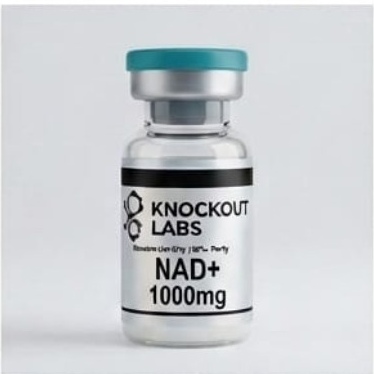
What does the 1000 mg amount mean?
The 1000 mg figure is the nominal quantity listed. Before converting it to an amount in moles, establish the form, its matching molecular weight, and whether the fill includes counterions, water or other material. A working concentration also requires the final volume.
Ask for the NAD+ specification and available lot report. Include the page link and, if known, the lot number. For a redox-sensitive assay, ask whether the method distinguishes NAD+ from NADH and which related nucleotides or degradation products it measures. Read any reported purity and quantitative content with their methods and units.
See the batch-report guide and the analytical testing guide for help reading the report. On receipt, match the lot to the label and record the product-specific storage instructions. The storage and stability guide covers the records needed for a prepared solution.
UK research supply
Price and availability appear in the product panel. Knockout Labs supplies UK customers aged 18 or over and reviews orders before acceptance. Read the research-use and buyer eligibility policy and UK delivery information.
Research Use Only. Not for human or veterinary use.
What do NAD measurements tell us?
An NAD measurement can describe a pool at one point in time, its rate of turnover, or the activity of an enzyme that consumes NAD+. Those results answer different questions. A measured change in one tissue or in plasma does not establish a benefit from this research material. [N2] [N3] [N5] [N6]
Read the enzyme, tracer and human studies
Enzyme activity, turnover and CD38
Imai and colleagues showed NAD-dependent histone deacetylation by yeast and mouse Sir2 proteins. Liu and colleagues used isotope tracers to follow NAD synthesis and breakdown and found different turnover rates across mouse tissues. One experiment measured an enzyme reaction, the other measured material moving through a pathway. [N2] [N3]
In mice, CD38 contributed to age-related changes in NAD metabolism. Changing an NAD-consuming enzyme has a different effect on an experiment from adding a defined amount of NAD+ as a reagent. [N4]
Human tissue and plasma measurements
Zhu and colleagues measured NAD+ and NADH in the brains of healthy volunteers. They found age-related differences in the measured forms. The study did not administer this product or test whether administering NAD+ changes brain function. [N5]
A small pilot study tracked NAD+ and its metabolites in plasma and urine after intravenous administration under study conditions. It addressed short-term metabolism. The authors did not establish a clinical benefit or a protocol for this laboratory material. [N6]
The NAD+, MOTS-c and glutathione comparison explains the distinct molecular classes represented in this catalogue.
Product questions
Is NAD+ a peptide?
No. It is a dinucleotide coenzyme. Its presence in the research-peptide catalogue does not change that molecular classification. [N1]
Is NAD+ the same as NMN or NR?
No. NMN and NR occupy different positions in NAD-related metabolic pathways. A study of one is not automatically evidence for a preparation of another. [N3]
Does 1000 mg specify the concentration of a working solution?
No. It is the nominal listed quantity. A concentration also needs a defined content basis and final volume. The reference identity and the supplied form must match the calculation.
Selected research sources
- N1. ChEBI. NAD+, CHEBI:15846.
- N2. Imai et al. (2000). NAD-dependent Sir2 deacetylation. Nature. DOI: 10.1038/35001622.
- N3. Liu et al. (2018). NAD synthesis and breakdown fluxes. Cell Metabolism. DOI: 10.1016/j.cmet.2018.03.018.
- N4. Camacho-Pereira et al. (2016). CD38, NAD decline and SIRT3. Cell Metabolism. DOI: 10.1016/j.cmet.2016.05.006.
- N5. Zhu et al. (2015). Human brain NAD and redox measurements. PNAS. DOI: 10.1073/pnas.1417921112.
- N6. Grant et al. (2019). Human plasma and urine NAD disposition. Frontiers in Aging Neuroscience. DOI: 10.3389/fnagi.2019.00257.