Description
What is the BPC-157 + TB-500 blend?
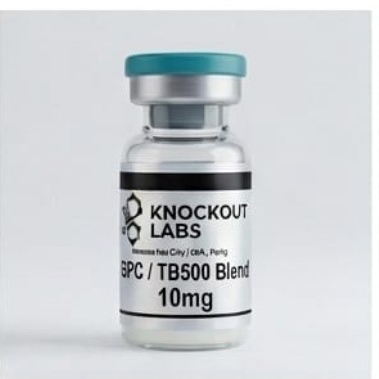
This listing combines two named research components in one formulation: BPC-157 5 mg and TB-500 5 mg. The combined nominal amount is 10 mg. A standalone BPC-157 10 mg product has a different declared composition; the two listings should not be treated as interchangeable.
The TB-500 name does not establish the exact supplied molecule. Confirm the sequence or unambiguous identity of that component, both supplied forms and the basis of each 5 mg declaration before selecting the material for an experiment. Research Use Only. Not for human or veterinary use.
| Product detail | What this listing states | What to confirm |
|---|---|---|
| BPC-157 component | 5 mg nominal amount | Supplied form, terminal chemistry and content basis |
| TB-500 component | 5 mg nominal amount | Exact sequence or molecular identity; fragment, full-length peptide or other specified form |
| Combined presentation | One co-formulated blend; 10 mg total nominal amount | Composition and analysis of the final blend, not only its starting materials |
| Price and availability | Shown in the live product panel above | Current values when making your selection |
| Lot documentation | Enquire for the product and lot being offered | Which specification, identity and quantitative results are available |
Equal nominal masses do not establish equal numbers of molecules. The amount labels are not a substitute for measured content or a complete product specification.
Ordering and technical information
This blend is supplied within the UK for laboratory research. Purchasers must be 18 or over, and orders undergo manual review before acceptance. Read the buyer-eligibility policy and delivery information. Not for human or veterinary use. For component-identity or document questions, contact technical support with the product name and page link, adding a lot or order reference if you have one.
Reading the blend specification and batch report
Before ordering: request the specification and available records for this blend, quoting “BPC-157 5 mg + TB-500 5 mg” and the product-page link. Ask which lot is being offered, how each component is identified, and what evidence supports each stated amount. If you have already received the product, include the container’s lot number and your order reference.
Document availability must be confirmed for the requested product and lot. The batch-report information page currently lists no downloadable lot reports; it explains what to request and how to match a record to the material.
For BPC-157, check sequence, terminal form and any counterion. For TB-500, require the exact sequence or otherwise unambiguous molecular identity, including whether it is a fragment, full-length thymosin β4 or a modified form. Then check how each nominal 5 mg quantity was determined and how the blend was configured.
Equal masses are not necessarily an equal molar ratio. The number of molecules represented by a mass depends on molecular weight, and that molecular weight depends on the identity being discussed. With an unresolved TB-500 identity, calculating a precise molar ratio would give a misleading appearance of certainty.
A blend also changes what a useful analytical result looks like. One overall chromatographic purity percentage does not demonstrate the quantity of both components. Ask whether the method can distinguish them, whether identity is supported for each and whether the content results refer to each component or only the mixture as a whole. The testing methods guide separates identity, chromatographic purity and quantitative assay.
Connect the report’s sample identifier with the blend’s lot number. A certificate for an individual starting material is relevant to that starting material; it does not automatically establish the composition or condition of the final co-formulated lot. The batch reports page provides the route for requesting matching records.
Receiving and handling a co-formulated material
At receipt, check that the container identifies the blend and both nominal quantities, and retain its lot reference with the laboratory inventory. Compare those details with the specification before preparing a working solution.
The preparation method needs to suit both components together. Solubility information for one peptide does not establish that the second component, or the blend, behaves the same way. A clear-looking solution does not verify the concentration of each peptide or exclude degradation. For an experiment that depends on a defined ratio, the preparation record should preserve how that ratio was established.
Use the documented conditions for this co-formulation, including any applicable solution-use interval. Record solvent composition, final volume, preparation time and storage history. The storage and stability guide provides the general framework; it is not a substitute for blend-specific evidence.
What can be concluded about the combination?
The cited papers address individual peptides, specific biological models or analytical identity. They do not establish a combined effect for this BPC-157 5 mg + TB-500 5 mg product. Similar research topics are not evidence of synergy.
A combination study would need appropriate individual-component and combination controls, with the actual chemical identities and exposure conditions stated. Otherwise, a response observed after adding a blend cannot reliably be assigned to BPC-157, the TB-500 component, their interaction or another difference in the preparation. This is an experimental-design consideration, not a claim that the mixture is ineffective.
| Question | Evidence that would answer it |
|---|---|
| Are both intended components present? | Component-resolving identity results linked to the actual lot |
| Is the stated amount of each present? | Quantitative content for each component, with the mass basis defined |
| Does a biological response come from the combination? | Individual-component and mixture comparisons in the same model |
| Is the mixture stable under the intended conditions? | Stability evidence for the combined preparation under those conditions |
For a wider comparison of the molecular identities, see BPC-157 and TB-500 compared.
Research evidence: what applies to this blend?
The selected papers concern BPC-157, a particular TB-500 preparation or full-length thymosin β4. They do not test this commercial blend or verify its lot.
- BPC-157: studies in rat tendon cells and explants examined migration, survival and growth-hormone receptor expression. The earlier study did not find a direct increase in fibroblast proliferation; the later growth-hormone-response experiment used an additional stimulus. These are experimental findings, not evidence that this blend treats human injuries. [B1] [B2]
- TB-500 identity: one analytical study identified Ac-LKKTETQ in the preparation tested. That result does not establish the identity of this blend’s TB-500 component. [B3]
- Thymosin β4: structural actin research examined thymosin β4–actin interactions, while the rat wound study investigated full-length thymosin β4. Neither establishes the effects of an unresolved TB-500 material or this commercial blend. [B4] [B5]
The BPC-157 profile and TB-500 identity profile provide the separate naming context.
Read the detailed component studies and reference-identity table
The following reference identities describe the cited research materials. They do not confirm the identity or composition of the lot offered here.
| Component or attribute | Reference or listing detail |
|---|---|
| BPC-157 | A 15-amino-acid peptide; GEPPPGKPADDAGLV is the sequence used in Chang and colleagues’ experiments [B2] |
| TB-500 in a published analytical study | An N-terminally acetylated seven-amino-acid fragment, Ac-LKKTETQ, corresponding to thymosin β4 residues 17–23 [B3] |
| Full-length thymosin β4 | A different peptide studied for actin interactions and tissue responses [B4] [B5] |
What the BPC-157 studies examined
BPC-157 has been investigated in experimental tissue and cellular models. For this product, the most useful papers are those that distinguish a measured cellular response from a broad claim about repair. Cell migration, survival under stress and proliferation are different endpoints, even when they contribute to the same experimental question.
Tendon-cell migration and FAK–paxillin signalling
Chang and colleagues’ 2011 study used rat Achilles-tendon explants and cultured tendon fibroblasts. BPC-157 increased explant outgrowth, cell migration and survival under hydrogen-peroxide stress. The study did not find a direct increase in fibroblast proliferation in its MTT assay. [B1]
The investigators also observed increased phosphorylation of focal adhesion kinase (FAK) and paxillin without an increase in their total protein amounts. These proteins participate in the cellular structures that connect adhesion with movement. The findings support investigating a signalling contribution to migration; they do not establish a single direct receptor for BPC-157. [B1]
That distinction is useful when reading a scratch or migration assay. More cells moving into an area can reflect movement, cell division, survival or a combination of these. An experiment that measures them separately provides a more informative result than a photograph of a closing gap alone.
Growth-hormone receptor expression
A 2014 study from the same research group examined rat tendon fibroblasts and reported increased growth-hormone receptor expression after BPC-157 exposure. When growth hormone was subsequently added, the cells showed greater proliferation-related responses and activation of JAK2, a downstream signalling protein. [B2]
This was a receptor-expression and cell-response experiment. It did not show that BPC-157 increases circulating growth hormone in a person. It also does not contradict the earlier finding that BPC-157 alone did not directly increase proliferation in that assay: the later experiment introduced an additional growth-hormone stimulus. These papers represent related work from one research programme, not two independent clinical demonstrations. [B2]
TB-500, thymosin β4 and the identity problem
What was identified in the TB-500 analytical paper?
Esposito and colleagues used chromatography and high-resolution mass spectrometry to identify Ac-LKKTETQ in the TB-500 preparation they analysed. They also synthesised the fragment and developed an analytical detection strategy. The “Ac” notation indicates an N-terminal acetyl group. [B3]
This gives a concrete published example of what TB-500 has contained. It is not a certificate for every preparation sold under that name. For this blend, the supplier specification and lot result must resolve the actual component. A report that says only “TB-500” leaves the central identity question unanswered.
What full-length thymosin β4 contributes to the research context
Xue and colleagues studied the structural interaction between thymosin β4 and actin, the protein that forms a major part of the cell’s internal filament system. Their structures showed binding at both ends of a single actin unit, helping explain how thymosin β4 can hold actin in a form that does not join a filament. The work also examined exchange with profilin, another actin-binding protein. [B4]
This is more specific than saying that thymosin β4 “increases actin.” It concerns the availability and organisation of actin units. Because the structural interactions involve more than a short isolated sequence, finding a shared fragment does not establish that the fragment reproduces the full peptide’s behaviour. [B4]
Malinda and colleagues investigated full-length thymosin β4 in a rat full-thickness wound model. They reported increased re-epithelialisation, collagen deposition and angiogenesis compared with controls, alongside a separate keratinocyte-migration experiment. Re-epithelialisation means coverage by epithelial cells; angiogenesis means formation of new blood vessels. [B5]
These findings explain the interest in thymosin β4 in tissue research. They were not obtained with this commercial blend, and the material studied must remain visible when the findings are summarised. They cannot establish efficacy for an unresolved TB-500 component or for human injury treatment. [B5]
Product questions
Is TB-500 necessarily full-length thymosin β4?
The name alone does not settle that. The published TB-500 analysis discussed here identified a short acetylated fragment. The current product specification must establish what is supplied in this blend. [B3]
Is this 10 mg of BPC-157?
No. The listing specifies 5 mg BPC-157 plus 5 mg TB-500. The total nominal mass does not change the declared quantity of either component.
Does combining the peptides prove a stronger effect?
No. A combined effect requires evidence from a defined combination experiment. The individual-component studies summarised here do not establish that result for this product.
Selected research sources
- B1. Chang et al. (2011). BPC-157, tendon outgrowth and migration. Journal of Applied Physiology. DOI: 10.1152/japplphysiol.00945.2010.
- B2. Chang et al. (2014). BPC-157 and growth-hormone receptor expression. Molecules. DOI: 10.3390/molecules191119066.
- B3. Esposito et al. (2012). TB-500 fragment characterisation. Drug Testing and Analysis. DOI: 10.1002/dta.1402.
- B4. Xue et al. (2014). Thymosin β4, profilin and actin exchange. PNAS. DOI: 10.1073/pnas.1412271111.
- B5. Malinda et al. (1999). Thymosin β4 in a wound model. Journal of Investigative Dermatology. DOI: 10.1046/j.1523-1747.1999.00708.x.