Description
What is GHK-Cu?
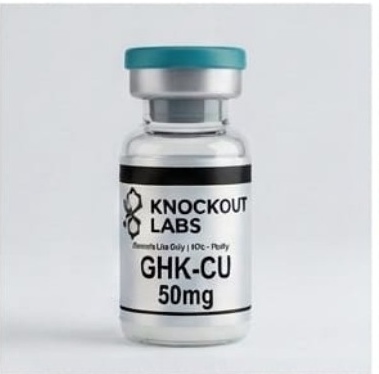
This GHK-Cu 50 mg listing is for UK laboratory research. Before selecting the material, confirm the exact copper-containing form and what the nominal 50 mg amount represents. The listing alone does not establish measured copper content, peptide content or a working concentration. Research Use Only. Not for human or veterinary use.
GHK-Cu is a copper(II) complex of the three-amino-acid peptide glycine–histidine–lysine. GHK is the peptide ligand: the part that binds the metal. Cu(II) identifies copper in the +2 oxidation state. Free GHK and its copper complex are related materials, but their names should not be used interchangeably. [G5]
| Product detail | What this listing states | What to confirm |
|---|---|---|
| Product | GHK-Cu 50 mg | The exact peptide, copper-containing form and lot being offered |
| Listed amount | 50 mg nominal quantity | Whether this means complex mass, peptide mass or another defined basis |
| Copper relationship | Requires the current specification | Declared copper-to-peptide ratio and the measurements supporting it |
| Supplied composition | Requires product and lot records | Complex form, counterions, water or other ingredients relevant to the amount |
| Price, availability and quantity offer | Shown in the live product panel above | The displayed price, stock and applicable offer when making your selection |
| Lot documentation | Enquire for the material being offered | Which identity, copper-content, purity and quantitative records are available |
The GHK-Cu compound profile explains the naming and coordination chemistry. For a different copper-peptide sequence, use the GHK-Cu and AHK-Cu comparison; the two names do not establish interchangeable materials.
Ordering and technical information
Current price, quantity-offer information and availability appear in the product panel above. Knockout Labs supplies within the UK for laboratory research. Purchasers must be 18 or over, and orders undergo manual review before acceptance. Read the buyer-eligibility policy and delivery information. Not for human or veterinary use.
For the mass basis, copper-complex specification or a matching lot record, contact technical support with the product name and page link, adding a lot or order reference if available.
Assessing the 50 mg material
Before ordering: request the GHK-Cu specification and available lot documents. Include the product name and page link, and ask which lot is being offered. Add an order or lot reference if you have one; an existing order is not needed to make this enquiry.
The batch-report information page currently lists no downloadable lot reports. Document availability must be confirmed for the requested product and lot.
Identity, copper content and quantity
Start by matching the product name and lot number to the specification. Ask how the peptide sequence and complex form are identified, what copper-to-peptide relationship is declared and how each part is measured. Check whether the 50 mg quantity includes counterions, water or other ingredients, or refers to a defined target-material content.
A chromatographic peak-area percentage describes the components detected under that method. It does not, on its own, establish copper content or the absolute quantity of target material. Likewise, observing a peptide-related mass does not settle the composition of a metal complex in solution. The testing methods guide separates identity, relative purity and quantitative content.
Płonka and colleagues studied selected Cu(II) complexes of ATCUN-family peptides. Under the tested electrospray mass-spectrometry conditions, the results underestimated solution binding constants. This finding concerns quantitative interpretation of metal binding; it does not mean that mass spectrometry has no analytical value. Check whether the method measures the property being claimed. The study does not provide a test result for this GHK-Cu lot. [G6]
| Question | Evidence to request |
|---|---|
| Which peptide and complex are supplied? | Defined identity, supplied form and appropriate supporting analysis |
| What does 50 mg measure? | Explicit mass basis and quantitative-content method |
| Is the stated copper relationship supported? | Copper and peptide measurements appropriate to the declared composition |
| Does the document describe this stock? | Matching product, lot and sample identifiers, with report date and version |
The batch reports page provides the route for requesting matching documents. A generic certificate or a result from another lot cannot resolve the current container’s composition.
Receiving, preparation and storage
Record the container’s product name, nominal quantity, lot reference and condition on receipt. Retain the applicable specification with the laboratory inventory. If the label and documentation use different mass bases, resolve the difference before calculating a concentration.
For solution work, record the solvent or buffer, pH where relevant, final volume, preparation time and storage history. A buffer is part of the experimental system, especially when metal coordination is relevant. Do not assume that a preparation used for free GHK, another copper peptide or a finished topical product establishes suitable conditions for this material.
Use storage conditions and any solution-use interval supported for the exact supplied form and container. Appearance alone cannot demonstrate identity, content or stability. The storage and stability guide explains what supporting information should accompany a handling instruction.
Research evidence: what applies to this material?
The selected papers address copper coordination, experimental biological responses and a small topical-regimen study. None verifies the identity, content or performance of the offered GHK-Cu lot.
- Coordination chemistry: GHK can bind copper, and the surrounding ligands and solution conditions matter. Research using a GHK tag on an engineered protein is a different application from selecting a free copper-peptide preparation. [G5]
- Cell and mouse models: studies report inflammatory, matrix and epithelial-junction responses under specific experimental conditions. These findings do not establish treatment effects in people or an outcome from this commercial material. [G1] [G2] [G3]
- Topical-regimen evidence: a small study after laser resurfacing found no between-group advantage on objective skin measures, although satisfaction favoured the GHK-Cu regimen. It tested finished skin-care regimens, not this research material. [G4]
Open the detailed discussion for the models, measurements and limitations. This is a selected research overview, not a systematic assessment of clinical effectiveness or a personal-use guide.
Read the detailed copper chemistry and research studies
The following findings concern the investigators’ own preparations and methods. They are not lot-specific test results for this listing.
Why the copper complex matters
GHK supplies three nitrogen donors to the copper coordination environment: its amino terminus, a peptide-bond nitrogen and the histidine side chain. Other ligands can complete that environment. The surrounding solution therefore matters when interpreting a metal–peptide preparation. [G5]
Mehr and colleagues demonstrated a separate laboratory application in 2020: a GHK tag attached to proteins helped crystallisation and structure determination using copper. Their structures showed neighbouring amino-acid groups completing the metal’s coordination environment. This was work with engineered protein constructs, not a test of this vial or evidence that free GHK-Cu can substitute for a protein tag. [G5]
For the supplied material, distinguish three questions: which peptide is present, how much copper is present, and what complex exists under the conditions being examined. A single answer rarely resolves all three. A declared 1:1 molar ratio, for example, describes numbers of copper ions and peptide molecules; it is not the same statement as equal masses.
Biological research: what the experiments found
Inflammatory signalling in cell and mouse models
Park and colleagues studied GHK-Cu in lipopolysaccharide-stimulated RAW 264.7 macrophages and a mouse model of acute lung injury. They reported lower reactive-oxygen-species production, greater superoxide-dismutase activity and lower TNF-α and IL-6 production, alongside suppression of NF-κB p65 and p38 MAPK signalling. Lung tissue also showed fewer infiltrating inflammatory cells and less histological disruption. [G1]
These measurements address different parts of the response. Reactive oxygen species are chemically reactive products; superoxide dismutase is an enzyme involved in handling one class of them; TNF-α and IL-6 are signalling proteins. Agreement between these endpoints supports a model-specific biological effect. It does not identify a universal GHK-Cu receptor or show that the commercial material treats a lung condition. [G1]
Matrix accumulation and TGF-β/Smad signalling
Ma and colleagues investigated GHK-Cu in mice with bleomycin-induced lung fibrosis. They reported less collagen deposition and inflammatory change, a shift in the MMP-9/TIMP-1 balance, and changes involving TGF-β1 and Smad2/3 phosphorylation. Their measurements also included α-SMA and fibronectin, markers used to investigate a transition towards a matrix-producing cellular phenotype. [G2]
Collagen accumulation and matrix turnover are related but distinct. MMPs participate in matrix breakdown, while TIMPs regulate their activity. A change in their measured balance provides context for the tissue findings; it is not a direct measurement of every step in collagen production or removal. This induced mouse model does not establish reversal of established human fibrosis. [G2]
Epithelial barriers and the STAT3 question
Mao and colleagues’ 2025 study combined a DSS-induced mouse colitis model with epithelial-cell/macrophage experiments. GHK-Cu was associated with less tissue injury and increased expression of the junction-associated proteins ZO-1 and occludin. In the cell experiments, silencing STAT3 removed the additional migration and junction-protein responses attributed to GHK-Cu. [G3]
That perturbation makes the work more informative than a list of pathway names: it tests whether changing a pathway component changes the response. The paper also used computational docking to propose SIRT1 involvement. Docking predicts a possible interaction; it does not by itself demonstrate direct binding or enzyme activation. The findings support further investigation of pathway dependence, without establishing a complete molecular mechanism or a human intestinal effect. [G3]
What a small topical study adds
Miller and colleagues randomised patients to skin-care regimens with or without GHK-Cu after carbon-dioxide laser resurfacing. Thirteen participants completed the study. Computer analysis and blinded assessors found no significant between-group advantage for redness resolution, wrinkles or overall skin quality. Patient-reported satisfaction favoured the GHK-Cu regimen. [G4]
The objective and subjective findings should both be retained. A satisfaction difference does not turn the objective comparisons into positive results, while a small study cannot resolve every possible formulation or endpoint. It also tested finished topical regimens after a procedure. This research container is not that formulation and is not supplied for cosmetic application. [G4]
Across these papers, the preparation, model and endpoint determine what a finding means. A cell-signalling response, a mouse tissue measurement and a participant’s questionnaire are not interchangeable evidence of an outcome for a buyer.
Product questions
Does 50 mg mean 50 mg of elemental copper?
The GHK-Cu 50 mg listing does not establish that it contains 50 mg of elemental copper. The specification must define whether the nominal amount refers to the copper complex, peptide ligand or another basis; any copper-content declaration needs its own evidence.
Is free GHK equivalent to GHK-Cu?
Free GHK is the peptide ligand; GHK-Cu describes a copper complex. They are not interchangeable names for a confirmed supplied material. Compare the peptide identity, metal content and experimental conditions. [G5]
Can another copper peptide be substituted on a mass-for-mass basis?
That requires an experimental justification. Different ligands have different identities, and equal masses need not represent equal amounts of substance. The GHK-Cu and AHK-Cu comparison explains the sequence distinction.
Is this a skin-care or cosmetic product?
No. This listing is for laboratory research material. It is not a finished skin-care formulation and is not supplied for personal cosmetic application, human use or veterinary use.
Selected research sources
- G1. Park et al. (2016). GHK-Cu in cell and mouse lung-injury models. Oncotarget. DOI: 10.18632/oncotarget.11168.
- G2. Ma et al. (2020). GHK-Cu in a bleomycin-induced fibrosis model. Life Sciences. DOI: 10.1016/j.lfs.2019.117139.
- G3. Mao et al. (2025). GHK-Cu, epithelial responses and STAT3. Frontiers in Pharmacology. DOI: 10.3389/fphar.2025.1551843.
- G4. Miller et al. (2006). GHK-Cu regimens after laser resurfacing. Archives of Facial Plastic Surgery. DOI: 10.1001/archfaci.8.4.252.
- G5. Mehr et al. (2020). GHK copper coordination and protein crystallography. Acta Crystallographica D. DOI: 10.1107/s2059798320013741.
- G6. Płonka et al. (2021). Electrospray and Cu(II)–peptide complex measurements. Journal of the American Society for Mass Spectrometry. DOI: 10.1021/jasms.1c00206.