Description
What is the CJC-1295 + Ipamorelin blend?
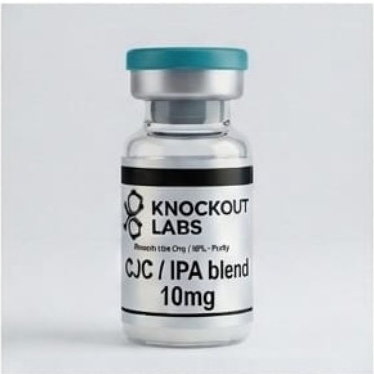
This listing combines CJC-1295 5 mg and Ipamorelin 5 mg in one research formulation. The total nominal amount is 10 mg. It is a blend, not a standalone 10 mg presentation of either component.
The exact CJC variant remains unresolved in the current product record. Confirm whether the supplied component carries the albumin-reactive DAC modification or is described using no-DAC terminology, then check its actual sequence and modifications. The specification must also identify the ipamorelin form and the basis of each nominal 5 mg amount. Research Use Only. Not for human or veterinary use.
| Product detail | What this listing states | What to confirm |
|---|---|---|
| CJC-1295 component | 5 mg nominal amount; exact variant unconfirmed | Sequence, DAC modification status, terminal form and content basis |
| Ipamorelin component | 5 mg nominal amount | Supplied molecular form, terminal chemistry and content basis |
| Combined presentation | One co-formulated blend; 10 mg total nominal amount | Composition and analysis of the final blend, not only its starting materials |
| Component relationship | Equal nominal masses | Molecular weights and content bases before calculating a molar ratio |
| Price and availability | Shown in the live product panel above | Current values when making your selection |
| Lot documentation | Enquire for the product and lot being offered | Which specification, identity and quantitative results are available |
The amount labels describe the offer; they do not replace measured component content or a complete specification. The DAC and no-DAC comparison explains why the CJC modification must be resolved before applying research on a particular construct.
Ordering and technical information
This blend is supplied within the UK for laboratory research. Purchasers must be 18 or over, and orders undergo manual review before acceptance. Read the buyer-eligibility policy and delivery information. Not for human or veterinary use. For variant or document questions, contact technical support with the product name and page link, adding a lot or order reference if you have one.
Assessing the blend specification
Before ordering: request the specification and available records for this blend, quoting “CJC-1295 5 mg + Ipamorelin 5 mg” and the product-page link. Ask which lot is being offered, which CJC variant it contains, how both components are identified and what supports each stated amount. You do not need an existing order reference to make this enquiry.
Document availability must be confirmed for the requested product and lot. The batch-report information page currently lists no downloadable lot reports; it explains what to request and how to match a record to the material.
Resolve both identities and quantities
Request the exact CJC sequence and modification status, the ipamorelin identity and terminal form, and any counterions or additional ingredients. The document should describe the final blend configuration, not merely name the two starting materials.
The nominal quantities are 5 mg of each component, not 10 mg of either one. Equal masses also do not establish equal numbers of molecules. A molar-ratio calculation requires the molecular weight and content basis for each supplied form; an unresolved CJC variant makes a precise ratio calculation premature.
A single overall chromatographic purity percentage cannot establish that both stated quantities are present. Check whether the method separates the constituents and relevant related components, how each identity is assigned, and whether the quantitative results apply to each constituent or only to the material as a whole. The testing methods guide explains why identity, peak-area purity and content are separate attributes.
Match the report to the final blend’s product and lot identifiers. A certificate for a starting peptide is evidence about that material; it does not automatically verify the condition or composition of the co-formulated lot. Request matching records through the batch reports page.
Receiving and preparation records
On receipt, check the product name, both nominal quantities, lot number and packaging condition. Retain the specification and analytical records together. Resolve any discrepancy in CJC variant or blend composition before treating the material as a known experimental input.
Preparation conditions must be appropriate for both constituents together. Solubility or stability information for one peptide cannot establish the behaviour of the mixture. Record solvent or buffer composition, amount used, final volume, preparation time and storage history. A clear solution does not verify either component’s concentration or exclude degradation.
Use storage conditions and any solution-use interval supported for this co-formulation. A half-life measured in a clinical study is not evidence of stability in a container. The storage and stability guide provides the general documentation framework.
What can be concluded about the combination?
The cited studies examine individual constituents, particular molecular modifications and defined experimental systems. They do not establish an additive or synergistic effect for this 5 mg + 5 mg commercial blend. Two mechanisms influencing a related hormone measurement are not, by themselves, a study of their interaction.
For a combination experiment, the actual CJC variant is a necessary starting point. Individual-component and mixture comparisons would then need compatible conditions and a stated endpoint. Otherwise, an observed response cannot be assigned confidently to one constituent, their interaction or a difference in preparation.
| Question | Evidence needed |
|---|---|
| Does each component have the intended identity? | Component-resolving analytical results matched to the exact supplied forms |
| Are the nominal amounts supported? | Separate quantitative content for CJC and ipamorelin, with each mass basis defined |
| Does the mixture alter a response? | Individual-component and combination controls within the same experimental system |
| Is the co-formulation stable? | Evidence for the actual combined material, container and conditions |
The CJC-1295 and ipamorelin comparison separates their molecular and receptor contexts. It is a comparison of identities, not a recommendation for a combined physiological use.
Research evidence: what applies to this blend?
The selected studies examine individual components and specific molecular forms. They do not test this commercial blend or verify its lot. Their findings help frame research questions; they are not evidence for personal treatment, recovery or performance use.
- CJC-1295: the original research investigated an albumin-reactive construct. Healthy-adult studies measured growth hormone and IGF-I responses to long-acting CJC-1295. Those results cannot be assigned to this blend while its CJC variant remains unresolved. [C1] [C3]
- Ipamorelin: animal experiments examined hormone selectivity, and a separate study in healthy male volunteers modelled peptide disposition and growth-hormone responses. These are different questions from the behaviour of a CJC/ipamorelin mixture. [C2] [C4]
- Clinical outcome: a small postoperative-ileus trial found no statistically significant difference between ipamorelin and placebo in its key or secondary efficacy analyses. Receptor activity does not by itself establish a clinical benefit, and that trial did not study this blend. [C5]
The CJC-1295 profile and ipamorelin profile provide the separate naming and receptor context.
Read the detailed component studies and reference-identity table
The reference identities below describe the cited research materials. They do not confirm the molecular forms or composition of the lot offered here.
| Component or attribute | Reference or listing detail |
|---|---|
| CJC-1295 in the original development work | A modified growth-hormone-releasing-factor analogue with an albumin-reactive group [C1] |
| Ipamorelin | A synthetic pentapeptide investigated as a growth-hormone secretagogue [C2] |
CJC-1295 research and the DAC distinction
What the original construct was designed to do
Jetté and colleagues’ 2005 work investigated modified human growth-hormone-releasing-factor peptides carrying a reactive group designed to attach to serum albumin. Albumin is a circulating protein; linking a peptide to it was intended to change how long the peptide remained in circulation. The albumin-linked preparations remained active in cultured rat pituitary cells. [C1]
In rats, the selected CJC-1295 construct produced a larger measured growth-hormone response than the reference hGRF(1–29) peptide, and an albumin-associated signal remained detectable beyond 24 hours. The molecular modification was part of the intervention. These results therefore support the specific construct’s design rationale, not a generic duration claim for anything labelled “CJC”. [C1]
What the healthy-adult studies measured
Teichman and colleagues reported two placebo-controlled studies of long-acting CJC-1295 in healthy adults. They measured peptide disposition and growth hormone and insulin-like growth factor I (IGF-I). The study reported sustained increases in those hormone measurements and an estimated CJC-1295 half-life of 5.8–8.1 days. [C3]
That estimate belongs to the studied construct and clinical conditions. It is not a shelf life, a preparation interval or a property established for this unresolved blend. The hormone endpoints also do not establish improvements in body composition, recovery or performance. Those would require their own appropriately designed studies and cannot be inferred from a rise in a blood marker. [C3]
What “no DAC” changes
“CJC-1295 without DAC” is used in market terminology for material lacking the albumin-reactive modification. It should not erase the structural distinction from the original CJC-1295 construct. Require the actual sequence and modifications, including the terminal chemistry, rather than selecting a theoretical mass from the familiar name alone.
The DAC and no-DAC comparison explains the identity problem. The product name alone does not establish which variant is supplied in the offered lot.
Ipamorelin: what selectivity meant in the experiments
Raun and colleagues described ipamorelin as the pentapeptide Aib-His-D-2-Nal-D-Phe-Lys-NH₂. Their experiments found growth-hormone release from rat pituitary cells and in animal models, with antagonist experiments supporting a GHRP-like receptor mechanism. This differed from the growth-hormone-releasing-hormone receptor route. [C2]
In swine, the investigators compared several hormone responses. Ipamorelin did not increase ACTH and cortisol significantly beyond the response observed with GHRH under the tested conditions, whereas the comparator secretagogues GHRP-2 and GHRP-6 did. This is the basis for a specific selectivity claim in that experiment. It is not evidence of no off-target effects, no adverse effects or the same hormone profile in every species and exposure condition. [C2]
The distinction is useful when reading a receptor study: a compound can show a preference within a tested panel without being exclusive to one biological effect. The panel, model and concentration determine how broad a conclusion is justified.
Human pharmacology is a different measurement
Gobburu and colleagues studied ipamorelin disposition and growth-hormone responses in healthy male volunteers. Their pharmacokinetic model estimated a terminal half-life of about two hours under the study’s infusion conditions. The hormone response was episodic, and between-person variability in the response parameters exceeded variability in the disposition parameters. [C4]
A measured peptide concentration and a measured biological response are therefore related but separate curves. Neither the hormone peak nor the terminal half-life alone describes every aspect of the response. These findings concern ipamorelin studied on its own; they do not establish the timing or behaviour of this co-formulation. [C4]
A clinical endpoint that did not show a significant benefit
Beck and colleagues’ multicentre phase 2 study examined ipamorelin after bowel-resection surgery. It enrolled 117 patients, with 114 included in the safety and modified intention-to-treat populations. Median time to tolerating a standardised solid meal was 25.3 hours with ipamorelin and 32.6 hours with placebo, but the difference was not statistically significant: p = 0.15. The paper reported no significant difference in its key or secondary efficacy analyses. [C5]
This is an important counterweight to assuming that receptor activity guarantees an intended clinical outcome. The trial concerned postoperative intestinal function, not a CJC/ipamorelin mixture, and it does not answer a different endpoint merely because the same peptide was involved. [C5]
Product questions
Does this listing confirm DAC or no DAC?
No. The existing product record leaves the exact CJC variant unresolved. The current specification and lot evidence must supply that answer.
Does the 10 mg total specify a working concentration?
No. The listing declares 5 mg + 5 mg nominal quantities. A concentration also needs a defined content basis and final volume for the preparation.
Do the individual studies prove a benefit from the blend?
No. The individual-component findings do not establish the behaviour or effectiveness of this combination, and the material is not supplied for personal use.
Selected research sources
- C1. Jetté et al. (2005). Albumin-linked GRF analogues in rats. Endocrinology. DOI: 10.1210/en.2004-1286.
- C2. Raun et al. (1998). Ipamorelin selectivity experiments. European Journal of Endocrinology. DOI: 10.1530/eje.0.1390552.
- C3. Teichman et al. (2006). Long-acting CJC-1295 in healthy adults. JCEM. DOI: 10.1210/jc.2005-1536.
- C4. Gobburu et al. (1999). Ipamorelin disposition and hormone-response modelling. Pharmaceutical Research. DOI: 10.1023/a:1018955126402.
- C5. Beck et al. (2014). Ipamorelin postoperative-ileus trial. International Journal of Colorectal Disease. DOI: 10.1007/s00384-014-2030-8.