Description
What is ARA-290?
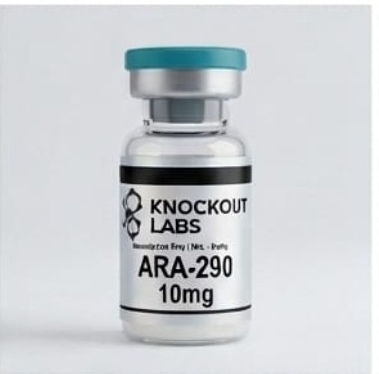
This ARA-290 10 mg listing offers a nominal quantity of material for UK laboratory research. Confirm the supplied molecular form and what the 10 mg declaration represents before using it in a calculation or selecting it for an experiment. Research Use Only. Not for human or veterinary use.
In the research literature, ARA-290 is also called cibinetide. It is an 11-residue peptide developed from the surface of erythropoietin’s helix B, not the full erythropoietin protein. A literature name does not verify the identity of a supplied lot. [A1] [A2]
| Product detail | What this listing states | What to confirm |
|---|---|---|
| Product | ARA-290 10 mg | Exact identity of the material and lot being offered |
| Listed amount | 10 mg nominal quantity | Whether the amount refers to total material or peptide content, and the evidence supporting it |
| Supplied form | Requires the current specification | Sequence, terminal modification, any salt or counterion, and additional ingredients |
| Price and availability | Shown in the live product panel above | Current values when making your selection |
| Lot documentation | Enquire for the product and lot being offered | Which specification, identity, purity and quantitative records are available |
| Research scope | Laboratory research only | Suitability for the intended experimental method; not for human or veterinary use |
The ARA-290 compound profile provides the naming and receptor context. The studies discussed below concern their own research preparations, not the quality or performance of this commercial lot.
Ordering and technical information
Knockout Labs supplies within the UK for laboratory research. Purchasers must be 18 or over, and orders undergo manual review before acceptance. Read the buyer-eligibility policy and delivery information. Not for human or veterinary use. For identity, supplied-form or document questions, contact technical support with the product name and page link, adding a lot or order reference if you have one.
Assessing ARA-290 10 mg
Before ordering: request the specification and available records for ARA-290 10 mg, quoting the product name and page link. Ask which lot is being offered, which molecular form it contains and what supports the stated amount. You do not need an existing order reference to make this enquiry.
Document availability must be confirmed for the requested product and lot. The batch-report information page currently lists no downloadable lot reports; it explains what to request and how to match a record to the material.
Match identity before comparing results
Check the full peptide identity rather than relying on “ARA-290” and “cibinetide” as interchangeable document headings. The specification should identify the sequence, terminal modification, any salt or counterion and additional ingredients. Where a database or certificate identifier is supplied, confirm that it resolves to that same chemical form.
The 10 mg declaration needs a defined content basis. Total material mass, target-peptide content and a calculated working concentration are different quantities. If a laboratory calculation uses a molecular weight, it must refer to the supplied form and the content basis used in the calculation.
Ask which analytical methods were performed on the actual lot. A molecular-mass result can support an identity assignment under the stated method; a relative chromatographic purity result describes detected components; a quantitative assay addresses amount or concentration. One should not be presented as proof of all three. The testing methods guide explains the distinctions.
Keep the report’s sample identifier, laboratory, test date, method and acceptance criteria with the lot record. A certificate for a different batch or an earlier starting material does not automatically establish the supplied container’s status. The batch reports page provides the document-request route.
Receiving and handling
Record the product name, nominal quantity, lot number and packaging condition on receipt. Compare the container with the specification and the document supplied. If the names or identifiers differ, obtain an explanation before treating the item as a defined experimental input.
For solution-based work, retain the source lot, documented form, amount used, solvent or buffer, final volume and preparation time. Use the laboratory method and material-specific documentation to establish suitable conditions. The clinical preparations in the cited papers are not interchangeable with this research listing.
Use storage conditions and any solution-use interval supported for the supplied form and container. No shelf life, temperature-excursion allowance or diluent compatibility is established by the nominal 10 mg quantity. The storage and stability guide explains what supporting evidence should accompany those instructions.
Research evidence: what applies to this product?
The selected studies examine receptor models, experimental injury responses and particular clinical endpoints. They do not verify the offered 10 mg lot or establish its suitability for personal treatment.
- Molecular design: early research tested an EPO-derived peptide designed to separate tissue responses from red-blood-cell stimulation. The findings concern defined experimental preparations, not a general safety claim for ARA-290. [A1]
- Sarcoidosis studies: a small pilot found an advantage on one neuropathy symptom scale, but not on every pain or fatigue measure. A later trial found a corneal nerve-fibre result in one study group without a statistically significant placebo-corrected pain result in the reported subgroup. Nerve structure and pain are separate outcomes. [A2] [A3]
- Type 2 diabetes study: researchers reported metabolic and symptom changes; the corneal nerve-density finding applied to a subgroup with reduced baseline density. That qualification limits how broadly the result can be interpreted. [A4]
These are selected early studies, not a systematic clinical assessment or evidence of a treatment offered by Knockout Labs. Open the detailed discussion for the populations, measurements and limitations.
Read the detailed receptor research and human studies
The findings below apply to the materials and conditions used by the investigators. None is a lot-specific identity, purity or content result for this product.
The receptor question behind the research
Erythropoietin’s classical receptor contains two EPOR units and supports erythroid-cell development. A different model combines EPOR with the common β-receptor subunit CD131. This proposed heteromer is often called the innate repair receptor. The distinction concerns receptor composition and experimental signalling; the name is not a promise of a product outcome. [A5]
In 2004, Brines and colleagues investigated EPO and carbamylated EPO using biochemical association experiments and injury models. They found evidence that EPOR and the common β subunit associated, and that the tested tissue-protective responses were lost in relevant models using β-subunit-knockout mice. This supported the heteroreceptor model. It was not a direct experiment with the later ARA-290 product. [A5]
A receptor hypothesis becomes more informative when its components are experimentally perturbed. Detecting two proteins together supports an association; losing a response after removing a component supports its functional involvement. Neither measurement should be replaced by an unqualified statement that a peptide activates a complete repair programme in every tissue. The innate repair receptor guide explains the terminology.
From a protein surface to a short peptide
Brines and colleagues’ 2008 work examined short peptides designed to reproduce the aqueous-facing surface of helix B. The pyroglutamate form of the surface peptide reduced biochemical indicators of renal injury in a mouse ischaemia–reperfusion model. A scrambled-sequence comparison in a separate stroke model did not reproduce the functional response. The peptides were nonerythropoietic in the tested assays. [A1]
These experiments help explain why sequence and terminal chemistry matter. They do not establish a clinical effect for an unspecified preparation, and “nonerythropoietic” describes a measured pharmacological distinction rather than universal safety. [A1]
Human studies: keep the endpoints separate
A small exploratory sarcoidosis trial
Heij and colleagues’ 2012 placebo-controlled pilot enrolled 22 people with sarcoidosis and symptoms of small-fibre neuropathy. After four weeks, the ARA-290 group improved more on the Small Fiber Neuropathy Screening List. Mean Brief Pain Inventory and fatigue scores improved to a similar extent in both groups, with no significant between-group advantage on those measures. [A3]
That pattern matters. A change on one symptom scale cannot be restated as a demonstrated benefit on every pain or fatigue measure. The small, exploratory trial also cannot establish uncommon harms or sustained effectiveness. It provides a reason to investigate specific endpoints, rather than a general claim that the peptide relieves neuropathy. [A3]
Corneal nerve measurements in a larger trial
Culver and colleagues’ 2017 phase 2b study randomised 64 people with sarcoidosis-associated small-nerve-fibre loss and neuropathic pain. Its primary endpoint was the change in corneal nerve-fibre area after 28 days. The middle-dose group showed a statistically significant placebo-corrected increase; the lower- and higher-dose groups did not meet that threshold for the primary comparison. [A2]
The study also found an increase in a skin marker of regenerating fibres in the middle-dose group. Pain improved in all groups, and the reported placebo-corrected pain comparison in the subgroup with moderate-to-severe pain was not statistically significant, with p = 0.157. A nerve-image measurement and a patient’s pain experience are different endpoints. The structural result should not be converted into a proven analgesic effect. [A2]
A study in type 2 diabetes
Brines and colleagues’ phase 2 study reported in 2015 examined ARA-290 in people with type 2 diabetes and painful neuropathy. Following a 28-day intervention and a further month of observation, the authors reported changes in HbA1c, lipid measurements and neuropathic symptoms. A corneal-nerve-density finding concerned participants whose baseline density was substantially below the normal reference. [A4]
That subgroup qualification belongs with the finding. A result in a selected population does not establish the same response in all participants, let alone people with a different condition. This study also used its own investigational preparation and clinical monitoring. It does not supply a use instruction, safety assurance or indication for this research product. [A4]
How to interpret this evidence
These publications connect molecular design, animal-model responses and early human measurements. They do not test the same thing repeatedly. The preclinical work addresses biological plausibility; the clinical studies examine particular populations and endpoints. A study can produce a positive surrogate measurement alongside an inconclusive symptom comparison.
| Evidence type | What the result addresses | What remains a separate question |
|---|---|---|
| Receptor-association or knockout experiment | Involvement of a receptor component in the tested model | Response to a commercial preparation in another system |
| Animal injury model | Defined tissue or biochemical endpoints | Clinical benefit in people |
| Corneal nerve imaging | Structural nerve measurement | Pain relief, function and durability |
| Questionnaire comparison | A specified symptom measure in the enrolled population | Other symptoms, populations and long-term outcomes |
Several papers share investigators and arise from the same development programme. They should not be counted as wholly independent confirmations. The sources selected here provide a research overview, not a systematic clinical assessment. None verifies the composition, purity or suitability of the offered 10 mg lot.
For laboratory work, specify which question the material is intended to address. A receptor-signalling experiment, a cell-survival assay and a structural nerve measurement need different controls and readouts. An observed response should be described at the level actually measured, with exposure conditions and the chemical identity of the test material retained.
Product questions
Is ARA-290 the same as erythropoietin?
No. It is a much smaller peptide developed from a surface-design concept. Findings about full EPO cannot simply be transferred to ARA-290, or vice versa.
Does a corneal nerve result prove pain relief?
No. A corneal nerve measurement describes nerve structure; pain relief is a separate outcome. The cited sarcoidosis studies show why structural findings and individual symptom measures need their own comparisons. [A2] [A3]
Does “nonerythropoietic” mean safe for personal use?
No. It describes a particular pharmacological property. This material is supplied for laboratory research, and the cited studies do not establish a personal-use regimen or general safety for it.
Selected research sources
- A1. Brines et al. (2008). Helix-B-derived nonerythropoietic peptides. PNAS. DOI: 10.1073/pnas.0805594105.
- A2. Culver et al. (2017). Cibinetide, nerve measurements and pain endpoints. IOVS. DOI: 10.1167/iovs.16-21291.
- A3. Heij et al. (2012). ARA-290 sarcoidosis pilot. Molecular Medicine. DOI: 10.2119/molmed.2012.00332.
- A4. Brines et al. (2015). ARA-290 in type 2 diabetes and neuropathy. Molecular Medicine. DOI: 10.2119/molmed.2014.00215.
- A5. Brines et al. (2004). EPO and common β-subunit receptor experiments. PNAS. DOI: 10.1073/pnas.0406491101.