Description
What does the 3 mL designation mean?
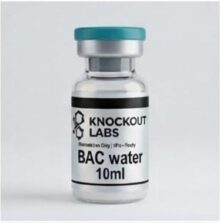
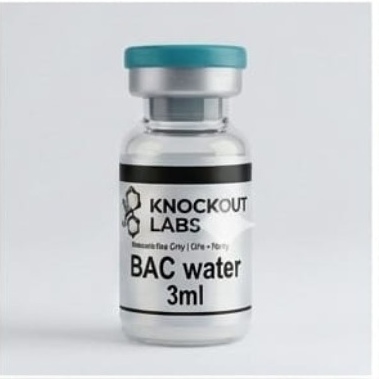
Bacteriostatic Water 3 mL is listed as a laboratory material in a 3 mL container. The volume distinguishes this item from the 10 mL product. It does not describe preservative strength, water grade, sterility or suitability for a particular experiment.
The term “bacteriostatic” concerns control of microbial growth. In a preserved formulation, effectiveness needs evidence under defined conditions. USP’s antimicrobial-effectiveness chapter addresses that property separately from chemical composition. [W1]
| Product detail | Record for this item |
|---|---|
| Product name | Bacteriostatic Water 3 mL |
| Nominal volume | 3 mL |
| Catalogue category | Laboratory material |
| Exact formulation | To be confirmed from the current product specification |
| Preservative identity and concentration | To be confirmed, with concentration units stated |
| Container, closure and lot evidence | Must apply to the 3 mL presentation supplied |
For the distinction between preservative content, microbial control and sterility, see the bacteriostatic water reference guide.
Is the 3 mL product equivalent to the 10 mL product?
A smaller fill does not, by itself, establish a different concentration. Equally, similar names and photographs do not prove that two products share the same formulation or specification. Compare the written records before treating the presentations as interchangeable.
| Comparison | What to establish |
|---|---|
| Ingredients and concentration | Whether both specifications identify the same components and amounts |
| Fill and container | Whether the stated volume, container material and closure correspond to each item |
| Lot documentation | Which product and lot each reported result covers |
| Stability evidence | Whether the conditions and presentation studied cover the 3 mL container |
| Shared qualification | Whether there is a documented justification for applying one study to both sizes |
ICH Q5C explains, within its scope of biological medicinal products, that bracketing fill volumes requires justified representativeness and that container interactions need consideration. The relevant principle here is to ask what a shared record actually covers. Citing the guidance does not establish that either Knockout Labs water product meets a pharmaceutical standard. [W9]
Does the name establish 0.9% benzyl alcohol?
No concentration is confirmed for this listing by its name. A US medicinal label on DailyMed specifies 0.9% benzyl alcohol for that particular manufacturer’s Bacteriostatic Water for Injection. That is an example of a documented formulation, not a specification for this 3 mL product. Request the actual ingredient record and concentration basis rather than transferring values from another label. [W10]
Records to match to your container
Ask for the specification and available records for the 3 mL container. Give the product link and, if you have it, the lot number from your label. To assess a 3 mL presentation, check which formulation, fill, container and closure the documents cover.
The batch-report guide explains how to request documentation. The testing-methods guide explains what the reported measurements can establish.
Availability and research supply
Knockout Labs supplies UK research buyers aged 18 or over. Orders undergo manual review. See the research-use and buyer eligibility policy and UK delivery information. The product panel shows the current price and stock for the 3 mL presentation.
Research / Laboratory Use Only. Not for human or veterinary use.
Storage and handling information
Check that the supplied storage instructions apply to the exact formulation and 3 mL container. On receipt, compare the label and lot reference with the accompanying documentation and inspect the closure condition. Contact support about a mismatch, damage or missing instruction.
Container size alone does not establish shelf life or an allowable period after opening. This page supplies no universal storage temperature or after-opening duration. Use a product-specific record covering the relevant conditions; the storage and stability guide explains the evidence to request.
Why compatibility depends on the formulation
Preservative studies can reach different results with different proteins. With the NIST model antibody, benzyl alcohol reduced conformational stability without increasing subvisible particles under the reported storage conditions. With trastuzumab under agitation, researchers found reduced monomer content and more particles. Both studies used their own formulations. Neither assessed this 3 mL water product with a specific research material. [W7] [W8]
Reading a microbiological report
Preservative amount, antimicrobial effectiveness and the microbiological condition of a lot are separate questions. A preservative-content assay measures the declared chemical component. It does not show whether the finished formulation controls microbial growth under a challenge test. [W1] [W2]
The sample can also interfere with the test. USP’s microbial-recovery chapter addresses demonstrating recovery in the presence of the product and neutralising antimicrobial activity where necessary. Without suitable recovery, a negative growth result can reflect inhibition during testing. Ask whether the method was shown to work for this formulation, not just whether a report says “pass”. [W3]
Endotoxin results need their own interpretation. Endotoxins are associated with Gram-negative bacteria and are not inactivated by most sterilisation methods. A chemical assay or a sterility result therefore cannot establish an endotoxin value. Look for a separate applicable method, result and acceptance criterion where that attribute is required. FDA’s technical presentation explains these testing principles; it is not a report on this product. [W4]
Selected research sources
- W1. USP (2017). General chapter <51>, Antimicrobial Effectiveness Testing.
- W2. USP (2017). General chapter <341>, Antimicrobial Agents:Content.
- W3. USP (2017). General chapter <1227>, Validation of Microbial Recovery from Pharmacopeial Articles.
- W4. FDA / Erika Pfeiler. The Bacterial Endotoxins Specification: Points to Consider.
- W7. Karunaratne et al. (2023). Interaction between preservatives and a monoclonal antibody in support of multidose formulation development. DOI: 10.1016/j.ijpharm.2023.123600.
- W8. Maharjan et al. (2025). Effects of antimicrobial preservatives on protein folding stability and subvisible particle formation in monoclonal antibody trastuzumab. DOI: 10.1016/j.ejpb.2025.114835.
- W9. ICH (1995). Q5C: Quality of Biotechnological Products:Stability Testing of Biotechnological/Biological Products.
- W10. DailyMed. Bacteriostatic Water for Injection, USP: product label, description section.