Description
What is Bacteriostatic Water 10 mL?
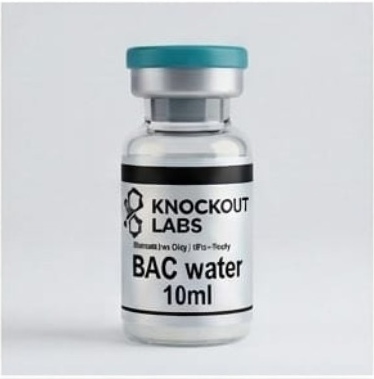
Bacteriostatic Water 10 mL is the larger of Knockout Labs’ two listed water containers. The 10 mL designation identifies the nominal volume. It does not establish the preservative identity or concentration, the water grade, or a tested microbiological specification.
An antimicrobial preservative controls microbial growth under defined conditions. Its effectiveness depends on the finished formulation and test used. USP’s antimicrobial-effectiveness chapter treats preservation as a distinct quality attribute. [W1]
| Product attribute | What this listing establishes |
|---|---|
| Product name | Bacteriostatic Water 10 mL |
| Listed volume | 10 mL nominal container fill |
| Material category | Laboratory material |
| Formulation and water grade | Require the current specification for this product |
| Preservative and concentration | Require identification and a stated concentration, including units |
| Sterility, endotoxin and container specification | Require separate, applicable documentation; not established by the name |
Some medicinal products use familiar terminology that can be mistaken for a universal formula. For example, one US DailyMed label for Bacteriostatic Water for Injection specifies 0.9% benzyl alcohol. That label describes a different manufacturer’s medicinal product; it is not evidence of the composition, grade or intended use of this Knockout Labs listing. [W10]
The bacteriostatic water reference guide explains what the name tells you about preservation and why sterility and compatibility require their own evidence.
Does the paperwork cover the 10 mL container?
Ask for the specification and available lot documents for the 10 mL presentation. Include the product link and any lot reference you have. Look for the formulation, fill volume, container and closure in the same record, or in documents that explicitly refer to one another.
The 3 mL container is a separate listing. A shared study is relevant only if its documentation explains why the findings cover both presentations. ICH describes this principle for certain biological medicinal products. Its guidance does not certify either laboratory water listing. [W9]
Use the batch-report guide to identify the record you need. The analytical methods guide explains what a content assay, sterility test or endotoxin result can establish.
Availability and UK research supply
Check the live product panel for the 10 mL price and availability. Knockout Labs supplies UK customers aged 18 or over and reviews orders before acceptance. Read the research-use and buyer eligibility policy and UK delivery information.
Research / Laboratory Use Only. Not for human or veterinary use.
Storage and receipt
Use storage and handling instructions that identify this formulation and container. Check the lot, closure condition and accompanying documents on receipt, and resolve missing or conflicting instructions with support before relying on the material.
No unopened shelf life, temperature-excursion allowance or period after opening is established on this page. Such limits need supporting evidence for the relevant conditions and presentation. The storage and stability guide explains what to look for in that record.
What does a preservative test tell you?
Preservative content, effectiveness and the lot’s microbiological quality need separate evidence. USP’s preservative-content chapter addresses chemical measurement; its antimicrobial-effectiveness chapter addresses preservation. One result cannot stand in for the other. [W1] [W2]
| Question | Evidence to examine | Limit of the result |
|---|---|---|
| What is in the water? | Specification, ingredient identity and quantitative composition | A declared recipe is not a measured result for every lot |
| How much preservative is present? | An appropriate quantitative assay and its units | Concentration alone does not demonstrate antimicrobial effectiveness [W2] |
| Does the formulation control microbial growth? | An applicable challenge study with defined organisms, conditions and acceptance criteria | It does not establish every other microbiological attribute [W1] |
| Was microbial recovery demonstrated? | Method suitability, including neutralisation of antimicrobial activity where needed | Preservative interference can prevent organisms from being recovered [W3] |
| What is the endotoxin result? | A separate, suitable endotoxin method and product-specific specification | Most sterilisation methods do not inactivate endotoxins [W4] |
Method suitability is especially relevant to preserved water. If a sample continues to inhibit organisms during a recovery test, a “no growth” observation may be misleading. USP’s microbial-recovery guidance requires the method to recover challenge organisms in the presence of the product and addresses neutralising antimicrobial activity. This is a reason to examine the method alongside the reported result. [W3]
Endotoxins originate from the outer membrane of Gram-negative bacteria. Their measurement addresses a different property from detecting viable organisms. FDA’s technical material explains why a specification needs a test, method and acceptance criterion suited to the product. These references explain testing principles; they do not certify this water or impose a medicinal-product specification on it. [W4]
How preservatives can affect a laboratory material
Experiments with recombinant human interleukin-1 receptor antagonist found that benzyl alcohol could favour partially unfolded forms and accelerate aggregation under the conditions tested. In a follow-up study, the effect depended on temperature. [W5] [W6]
A study of a different protein, the NIST model antibody, found a change in conformational stability without a corresponding increase in subvisible particles with benzyl alcohol. These results show why a compatibility record should identify the protein, formulation, conditions and measurement. They do not establish compatibility for this water or any particular peptide. [W7]
Selected research sources
- W1. USP (2017). General chapter <51>, Antimicrobial Effectiveness Testing.
- W2. USP (2017). General chapter <341>, Antimicrobial Agents:Content.
- W3. USP (2017). General chapter <1227>, Validation of Microbial Recovery from Pharmacopeial Articles.
- W4. FDA / Erika Pfeiler. The Bacterial Endotoxins Specification: Points to Consider.
- W5. Zhang et al. (2004). Mechanism for benzyl alcohol-induced aggregation of recombinant human interleukin-1 receptor antagonist in aqueous solution. DOI: 10.1002/jps.20219.
- W6. Roy et al. (2006). Temperature dependence of benzyl alcohol- and ANS-induced aggregation of recombinant human interleukin-1 receptor antagonist. DOI: 10.1021/bi052132g.
- W7. Karunaratne et al. (2023). Interaction between preservatives and a monoclonal antibody in support of multidose formulation development. DOI: 10.1016/j.ijpharm.2023.123600.
- W9. ICH (1995). Q5C: Quality of Biotechnological Products:Stability Testing of Biotechnological/Biological Products.
- W10. DailyMed. Bacteriostatic Water for Injection, USP: product label, description section.